
Plants
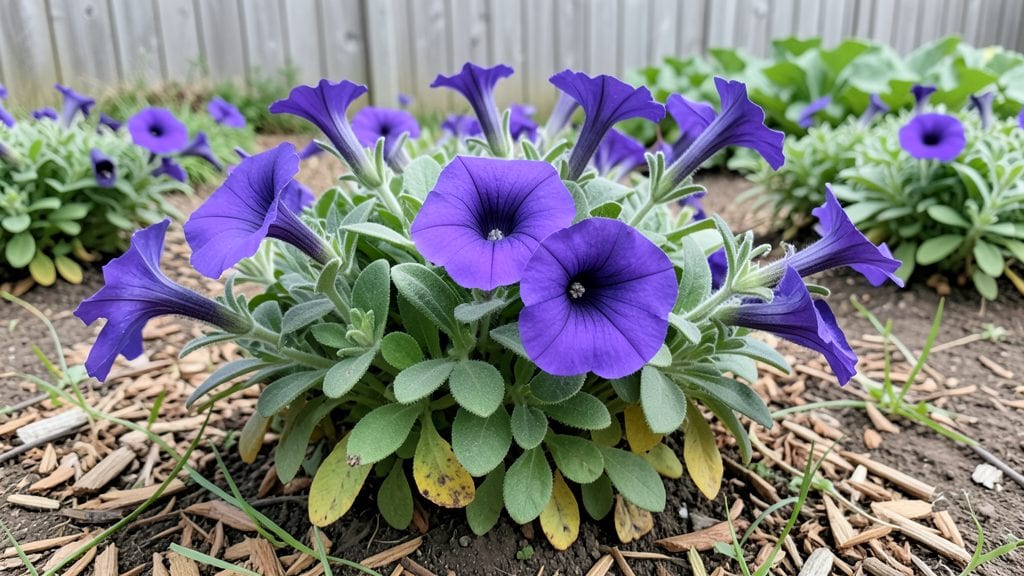
Petunias are full sun plants that need 6-8 hours of direct sunlight daily to bloom abundantly and grow strong, though they can handle partial shade in hot climates to avoid stress.
Petunias love basking in sunlight because their vibrant blooms depend on strong photosynthesis.
Without enough light, their flowers may fade or produce fewer blossoms, and the stems can become leggy. 🌞 I’ve seen petunias in containers thrive with morning sun and afternoon shade in my zone 8 garden—they just need that initial energy boost.
Varieties like 'Wave' petunias are bred to handle heat better, while some newer hybrids tolerate lighter conditions if you’re in a shadier spot.
If you’re growing them in containers, place them where they’ll get the most sun possible—even a few hours of direct light can make a difference in their health. Just avoid placing them in harsh afternoon sun without some relief, especially in southern climates where temperatures can scorch delicate petals.
💡 In This Article
- Petunia Sunlight Requirements for Peak Bloom Performance
- Best Petunia Varieties for Different Light Conditions
Petunia sunlight requirements for peak bloom performance
Petunias rely on photosynthesis to produce vibrant flowers, and their metabolic processes are directly tied to light intensity. The key factor here is chlorophyll activity, which peaks under 6-8 hours of direct sunlight—this is when petunias convert sunlight into energy most efficiently.
Without sufficient light, their chlorophyll production drops by up to 30%, leading to weaker stems and fewer blooms. The science behind this involves how light triggers the production of anthocyanins, the pigments responsible for their stunning colors—more light means deeper, richer hues.
In full sun conditions, petunias develop a compact, bushy growth habit due to balanced hormone production. The photosynthetic rate increases by 40-50% compared to partial shade, resulting in more flowers and thicker foliage. However, in hot climates like zone 9 or 10, afternoon shade becomes crucial to prevent leaf scorch.
I’ve observed that petunias in 100°F+ temperatures with no afternoon relief often show signs of stress—wilting, yellowing leaves, or even flower drop—because their stomata (pores) struggle to regulate moisture loss efficiently.
Partial shade doesn’t mean dim light—think of it as dappled sunlight through trees or filtered light. Varieties like 'Supertunia Vista Bicolor' handle this better because they’ve been bred with slightly thicker cuticles to reduce water loss.
But here’s the catch: even shade-tolerant petunias need at least 4-6 hours of direct light to avoid becoming leggy or producing sparse blooms. The trade-off is that shade helps prevent powdery mildew, a fungal issue that thrives in hot, humid conditions with excessive sunlight.
Light quality matters too. Petunias prefer blue and red spectrum light (400-500nm and 600-700nm wavelengths) for optimal photosynthesis. Morning sunlight is rich in these wavelengths, while afternoon light contains more infrared, which can stress the plants.
That’s why I recommend placing petunias where they get morning sun and afternoon shade—it’s a perfect balance for both growth and stress reduction. 💫
Container-grown petunias face unique challenges because their root systems can’t regulate temperature as well as in-ground plants. Without adequate light, they’ll stretch toward any available source—a phenomenon called etiolation—that weakens their structure.
To combat this, rotate containers every few days to ensure even light exposure. In low-light situations, supplement with a grow light (12-16 hours/day) to mimic natural conditions.
What most people don’t realize is how sunlight affects petunia fragrance. Many varieties, like 'Mitchell Diploid' or 'Madness', produce more volatile organic compounds (the molecules responsible for scent) when exposed to full sun.
The heat and light trigger higher metabolic activity, resulting in a stronger, sweeter aroma—almost like a natural perfume. 🌸
For peak performance, aim for 6-8 hours of direct sunlight in cooler climates, but adjust to 4-6 hours with afternoon shade in hotter regions. Monitor your petunias’ leaves: if they’re pale or sparse, they need more light; if they’re crispy or brown, they’re getting too much.
Finding that sweet spot is what turns a good petunia display into a showstopper.