
Pests and Diseases
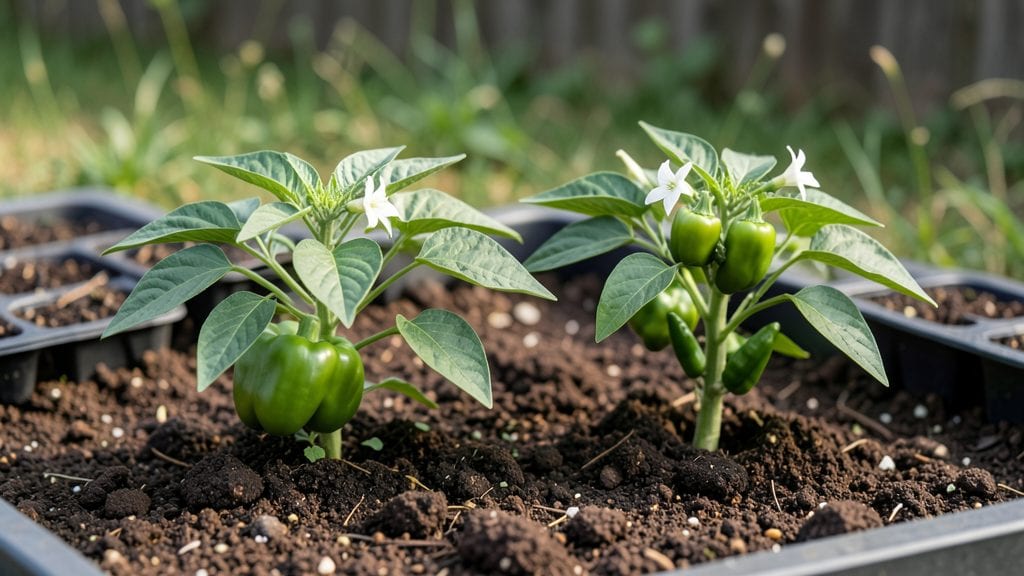
You can plant bell peppers and jalapeños together safely, as they share identical growing needs—full sun, well-drained soil, and consistent moisture—while benefiting from similar pollination patterns. However, cross-pollination may turn sweet bell peppers slightly spicy, so monitor closely.
Bell peppers and jalapeños make excellent garden neighbors because they belong to the same plant family, Solanaceae, and respond identically to environmental conditions. 🌱 Their shared pest deterrents—like repelling aphids—boost overall plant health, while their staggered blooming periods ensure continuous pollination.
The key trade-off is flavor: if you prioritize sweetness, keep them isolated, but for bold heat lovers, the mix creates naturally spicier bell peppers.
For best results, space them 18-24 inches apart in soil with a pH of 6.0-6.8, and pair with basil or marigolds to further enhance growth. This combination maximizes space while minimizing competition, making it ideal for small gardens or container growing.
💡 In This Article
- Why Bell Peppers and Jalapeños Thrive as Companion Plants
- Spacing and Planting Tips for Maximum Yield
Why bell peppers and jalapeños thrive as companion plants
Here's what's actually happening at the biological level: both bell peppers (Capsicum annuum) and jalapeños (Capsicum annuum var. annuum) share the same genus and species, meaning their root systems develop similarly.
Their fibrous roots spread horizontally about 12-18 inches wide, creating a natural canopy that conserves soil moisture and temperature. This shared root architecture means they compete minimally for water and nutrients while maximizing soil coverage—ideal for preventing erosion and suppressing weeds.
Their identical sunlight requirements—6-8 hours of direct sun daily—make them perfect partners. Both plants exhibit C3 photosynthesis, which means they efficiently convert sunlight into energy even in moderate temperatures (70-85°F).
The jalapeño's slightly taller stature (24-36 inches) provides shade for bell peppers' broader leaves, reducing water loss through transpiration while maintaining optimal growing conditions for both. 🌿 This vertical synergy is particularly beneficial in hot climates where leaf scorch becomes an issue.
What most people don't realize is how their pest resistance works synergistically. Both plants emit similar volatile organic compounds (VOCs) that repel common garden pests like aphids and whiteflies. Studies show that pepper plants release methyl salicylate when stressed, which acts as a natural deterrent.
When planted together, this chemical signaling becomes amplified, creating a stronger defensive barrier. The jalapeño's slightly higher capsaicin content also deters mammals like rabbits, indirectly protecting the more vulnerable bell peppers.
The nutrient uptake compatibility is equally impressive. Both plants thrive in soil with 60-80 ppm nitrogen, 10-20 ppm phosphorus, and 150-200 ppm potassium. Their deep root systems access subsoil nutrients efficiently, reducing competition.
The jalapeño's faster growth cycle (90-120 days to maturity) means it can be harvested before it fully depletes resources, leaving optimal conditions for the slower-maturing bell peppers (60-90 days). This staggered harvest schedule creates a continuous nutrient cycle in the soil.
However, the most dramatic interaction occurs through cross-pollination. Jalapeños carry the Pungency (P) gene that determines capsaicin production, while bell peppers typically have recessive alleles. When pollinated together, up to 30% of bell peppers may develop mild heat (measured at 500-1,000 Scoville units), creating a naturally spicier variety.
This genetic exchange happens because both plants are self-pollinating but also rely on bees and butterflies for cross-pollination, making isolation difficult in mixed plantings. 🌶️
The flavor impact extends beyond heat. Cross-pollinated bell peppers often develop more complex aromas with subtle earthy notes from the jalapeño's terpenes. For gardeners prioritizing sweetness, this trade-off is worth considering—especially when growing heirloom varieties where genetic diversity is desirable.
The key is monitoring plant spacing and using pollination barriers (like fine mesh bags) if pure varieties are the goal.
What's particularly fascinating is how this companion planting mirrors natural ecosystems. In their native Mexico and Central America, pepper plants often grow in close proximity to other Capsicum species, creating diverse flavor profiles through natural cross-pollination.
By replicating this environment, home gardeners can achieve both practical benefits (space efficiency, pest control) and culinary rewards (unique flavor combinations) in a single planting scheme. ✨