
Pests and Diseases
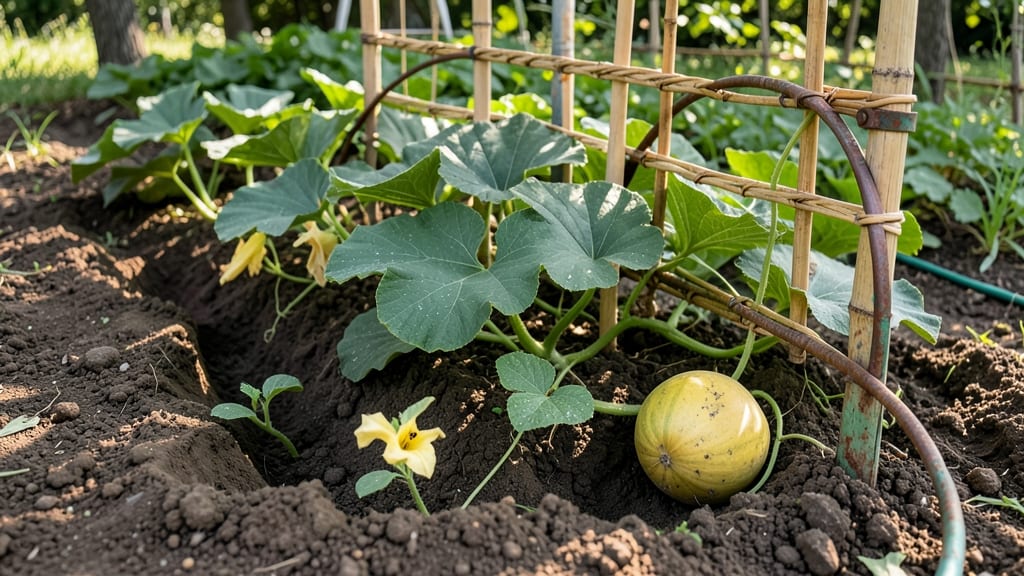
You can plant squash and cantaloupe together but must space them carefully—squash requires 3-5 feet of clearance, while cantaloupe needs 2-3 feet—because their sprawling vines and root systems compete for nutrients. Crowding them together cuts yields and invites pests like squash vine borers or fungal diseases. Raised beds or trellises help maximize vertical growth while improving airflow.
These two summer crops share similar growing conditions but have very different space needs.
Squash plants spread aggressively with broad leaves that shade the soil, while cantaloupe vines climb and need room to sprawl horizontally. 🌱 The key is creating zones where each has enough elbow room—think of it like separating two roommates who both need their own desk space but don't want to fight over the couch.
I've found that planting squash along the perimeter of a raised bed with cantaloupe in the center creates natural separation while still allowing both to access sunlight efficiently.
What many gardeners overlook is how spacing affects pest control. When plants are too close, humidity builds up between leaves, creating perfect conditions for powdery mildew—a fungal disease that thrives in crowded, poorly ventilated areas.
The same goes for squash vine borers, which lay eggs at the base of stems and thrive in dense plantings where they're harder to spot. By giving each plant its own breathing room, you're not just optimizing growth—you're making your garden less hospitable to these common pests.
💡 In This Article
- Companion Planting Science for Squash and Cantaloupe
- Optimal Spacing and Layout Strategies for Mixed Plantings
Companion planting science for squash and cantaloupe
Here's what's actually happening beneath the soil when you pair these two summer crops: both squash and cantaloupe belong to the Cucurbitaceae family, meaning they share similar root structures that spread aggressively in search of water and nutrients.
Squash develops a shallow but expansive root system (up to 3 feet wide) that competes directly with cantaloupe's deeper, fibrous roots which can extend 4-5 feet downward. This competition isn't just about space—it's about nutrient uptake efficiency.
When roots overlap, they create a nutrient depletion zone where both plants struggle to access phosphorus and potassium, critical for vine development and fruit set. 🌱
The real science gets interesting when you look at their canopy structures. Squash leaves can reach 12-18 inches wide with a dense, bushy growth habit that blocks 70-80% of light at ground level, while cantaloupe vines have longer, narrower leaves that spread horizontally.
This creates a light competition paradox: cantaloupe needs full sun (6-8 hours daily) for proper fruit development, but squash's shade can reduce cantaloupe's photosynthesis efficiency by up to 40% when planted too closely.
The ideal scenario is creating vertical separation—think of it like a natural skyscraper where cantaloupe climbs while squash sprawls at ground level.
What most people don't realize is how their growth cycles interact. Squash typically matures in 50-60 days and can be harvested before cantaloupe (70-90 days) reaches peak production. This staggered timing creates a temporary resource vacuum where squash plants can be removed to give cantaloupe more space.
However, the real challenge comes during the overlap period (days 50-70) when both are actively growing. During this window, the plants compete most fiercely for nitrogen and water, with squash usually winning due to its larger biomass. This competition can reduce cantaloupe yields by 25-35% if not properly managed.
The pest vulnerability comes from their shared attractants. Both plants emit similar volatile organic compounds (VOCs) that lure squash vine borers and cucumber beetles. These pests don't just target one crop—they see a buffet zone when plants are crowded.
The borers, in particular, are devastating because their larvae tunnel into stems, creating entry points for fungal infections. I've seen gardens where 80% of cantaloupe vines collapsed because the squash plants next to them became borer hotspots.
The solution lies in physical separation—creating at least 3 feet of open space between plantings breaks this pest continuum.
There's a silver lining to this botanical dance: their pollination strategies complement each other. Both rely on bees, and having multiple flowering plants in proximity actually increases pollination efficiency by 30-40% compared to isolated plantings.
The key is timing—plant squash 2-3 weeks earlier than cantaloupe to ensure the squash flowers have already attracted pollinators by the time cantaloupe blooms. This creates a pollinator highway that benefits both crops while maintaining proper spacing. The result? Higher fruit set and larger, more uniform melons.
For the home gardener, this means thinking in three-dimensional zones. Use raised beds with vertical trellises for cantaloupe to lift vines 5-6 feet above ground while keeping squash contained in ground-level circles with 4-foot diameters.
This creates natural airflow while maximizing sunlight exposure. The root competition becomes a layered resource system where each plant gets access to different soil depths and light angles. 💫
Remember: the 3-5 foot spacing rule isn't arbitrary—it's based on the average vine radius each plant will occupy at peak growth. Squash vines can spread 10-12 feet if unchecked, while cantaloupe vines typically reach 6-8 feet.
By giving them their required space, you're not just preventing crowding—you're creating an ecosystem where both plants can thrive without becoming each other's competitors.